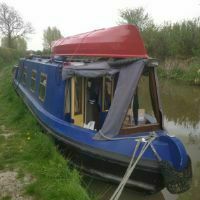

Over the last few days pottering around on the cut in the Birmingham area I've come across a couple of these electric boats, one privately owned and one a hire boat. Rather than a load of solar panels on the roof, giving the opportunity (during the summer!) of travelling the system for 'free', they both operate on a generator system and I really need someone who understands it to explain the logic to me. From what I can see the system works by running the generator (therefore burning diesel) to charge the batteries up. You then run the batteries down driving the boat along the cut and then fire up the generator again. Now I may be mis-remembering my school days (they were a while ago!) but I seem to remember something about every time you transform one form of energy into another you are going to lose some of it. So it seems they transform the energy of the diesel into electrical energy via the generator and then transform the electrical energy from the batteries into rotational energy to drive the propeller. Genuine question and I'm not trying to be contrary, but how is that more efficient than simply using the energy of the diesel to drive the propeller? What am I missing here? The other notable thing about the electric boats I saw was just how slow they were. Not a problem as they were at least travelling at a speed just fast enough that I could remain behind them on minimum tickover, but my experience of driving electric cars is that their acceleration and performance equals ICE cars (and sometimes exceeds it). So why are electric boats so slow, or were these two just anomalies? I'm not anti-electric boats/vehicles and if there was a charging infrastructure on the canals, all well and good (although there are probably other things that need fixing first) but IF I were going for one it would need sufficient solar panels, this 'hybrid' idea seems a bit pointless to me if you are still burning diesel.