

Up-Side-Down
Member
-
Joined
-
Last visited
-
If you do decide to stick with LA batteries here's a device (courtesy of AI) that will maximise their charging ... and a Sterling device with longevity going on a friends 21-year installation: The Sterling Power Pro Split R (often referred to as an alternator combiner, split isolator, or 0V drop alternator splitter) is an intelligent charging current distributor designed to send power from one or two alternators to multiple battery banks (such as an engine start battery and one or more domestic/house battery banks) without the traditional voltage losses of standard diodes. But do bear in mind that lithium batteries are now cheaper than quality AGM LAs (Ah for Ah) and can safely deliver 90% + of their stored charge against an LA's 50%. This makes changing to lithium a no brainer and allows some money over to make the necessary changes to the existing electrical system.
-
In the light of new issues discovered whilst repairing the breach I think this commentary deserves more exposure than it will get on 'The Other Side'. I therefore make no apology for reproducing it wholesale, nor for suggesting readers also seek out Ralph Freeman's excellent (being both original and eminently workable) thoughts on a re-imagined lengthsman for contemporary waterways management – Campbell Robb and his team please note! The Whitchurch embankment failure The Whitchurch embankment failure by Ralph Freeman An engineering analysis of modern framework. Civils vs. pioneer heritage systems Executive summary The ongoing difficulties experienced by the Canal & River Trust (CRT) and its primary framework contractors (Kier) at the Whitchurch Embankment stem from a fundamental methodology gap: treating a dynamic, 19th-century hydraulic soil-structure interaction model with rigid 21st century civil engineering interventions. Rather than working from the starting point of reverse-engineering the original design logic, corporate framework management often dismisses historic features as primitive or accidental. This institutional arrogance—unsubstantiated by any track record of building 200-year infrastructure—has led to interventions that actively conflict with the underlying physics of the original asset. 1. Respecting the master builder: Newtonian mechanics and structural margin A persistent error in modern asset evaluations is the assumption that 19th-century pioneers like Thomas Telford, William Jessop, and John Rennie relied on crude guesswork. By the turn of the 19th century, civil engineering was firmly anchored in Newtonian mechanics, vector statics, calculus, and hydrostatic theory. These engineers designed masonry arches, aqueducts, and retaining structures with deliberate geometric stability. They ensured the resultant lines of thrust stayed strictly within the middle third of masonry sections to prevent tension failure, and they incorporated generous factors of safety (frequently 3 to 5+) to accommodate unquantifiable loads and variable soil mechanics. When modern framework engineers analyse these assets through simplified structural modelling software or standardised Eurocodes, they frequently misinterpret flexible, self-supporting geometry as 'unstable' or 'failing', simply because it does not fit modern byrigid material assumptions. 2. Reverse engineering the asset: The Whitchurch Culvert clay buffers In complex engineering systems, an unusual feature is rarely a mistake; it is usually a calculated response to an unseen constraint. A prime example is the presence of puddled clay intentionally placed directly over the crown of the masonry culverts within the deep Whitchurch Embankments. Where corporate inspectors have previously dismissed this clay layer as a "quality error" or 'accidental fill dropped by a navvy', structural mechanics demonstrates a clear, deliberate load-redistribution function: 1. Quasi-Hydraulic Cushioning: Deep earth embankments exert massive, non-uniform overburden pressure. Placing a flexible, cohesive puddled clay layer over a rigid masonry arch creates a compressible buffer that deforms slightly under fill load, smoothing stress concentrations across the arch extrados. 2. Soil Arching Mechanism: By allowing micro-settlement directly above the crown, the clay layer encourages the surrounding earth mass to develop internal shearing resistance. This triggers natural soil arching within the embankment, shifting primary vertical loads away from the culvert crown and into the adjacent shoulders. 3. Hydraulic Steering: The clay acts as an impermeable barrier, directing groundwater away from the masonry extrados and preventing hydrostatic head build-up behind the arch. Navvies did not haul and puddle expensive clay to dump it by chance at depth over critical culverts. It was a sophisticated workaround to preserve the structural integrity of the culvert beneath a massive embankment. 3. Ground mechanics and geotechnical reality at Whitchurch The site dynamics at Whitchurch compound these structural challenges due to exceptionally complex ground conditions. Stable bedrock lies 80 to 100 feet below the surface, separated by a deep, non-homogeneous stratum of glacial moraine—a chaotic matrix of gravel pockets, sand lenses, and soft clays. Pioneer engineers recognised that rigidly keying a structure into such unpredictable, differential strata was impossible without driving immense costs or inducing catastrophic shear failure. Consequently, the embankment and its underlying culverts were explicitly engineered as a flexible, dynamic system capable of accommodating ongoing micro-settlement and ground movement without brittle fracture. When modern interventions introduce rigid concrete foundations, stiff ground anchors, or heavy sheet piling into this shifting glacial drift, they create localised zones of extreme stiffness. Instead of stabilising the slope, these rigid inclusions concentrate stress, block natural groundwater pathways through the moraine, and force differential movement into adjacent unreinforced sections—effectively triggering new failures further down the embankment. 4. The arrogance of compliance over capability The current struggle to stabilise assets like Whitchurch highlights a stark contrast in capability and design philosophy between modern framework contractors and original pioneer engineers. Modern tier-one contractors excel at process management, NEC4 contract administration, CDM safety compliance, and executing heavy, standardised civils. However, their core competence lies in liability management—not in constructing or maintaining dynamic, breathable hydraulic masonry. ♦ Design Horizons: Modern standard civils are built for 50- to 100-year design lives using concrete, steel sheet piling, and polymer grouts. When faced with an asset meant to endure for centuries under pure geometric compression and flexible moisture movement, modern teams default to rigid, impermeable fixes. ♦ Destructive Interventions: Injecting rigid cementitious grouts or driving steel sheet piling through historically flexible earthworks alters the original load paths. Cement traps groundwater, eliminates breathing capability, increases hydrostatic pressures, and forces frost-spalling on historic brickwork—accelerating failure instead of preventing it. ♦ Sub-Contracted Expertise: The tier-one contractor primarily acts as an administrative envelope. The specialised trade crafts—lime mortar restoration, traditional timber work, and historic masonry—are sub-contracted out, often isolating the decision-makers from the true mechanics of the structure. Conclusion CRT and its framework contractors are floundering at Whitchurch because they approach the navigation as a collection of static, decaying assets requiring modern concrete stabilisation, rather than a dynamic hydraulic system engineered with deep physical insight. True repair and preservation require a shift in perspective: setting aside corporate regulatory arrogance, assuming the original designers knew precisely what they were doing, and understanding the physical mechanics of 200 years old structures before attempting to alter them.
-
Apart from the eastern end of the Engine Arm, running off the Oxford Canal near Napton, I can think of very few mooring sites that allow anywhere like enough exposure to the wind. My 100W Ampair unit was as much use as a chocolate fireguard, even on exposed coastal sites. I was very glad it was a gift and I hadn't wasted good money on it!
-
If you: i) are prepared to pay for a professional installation ii) want a slightly different take on your requirements iii) are in the Midlands (or are prepared to cruise there) have a chat with Kevin Mascall on 07929 140069.
-
My understanding of the science is that the configuration that produces the most efficient temperature gradient (and therefore flue draught) is the one to go for. As such I was always taught that running the first couple of metres in single wall flue pipe achieved this most effectively.
-
https://www.ignitionfires.com/blog/understanding-flues-for-wood-burning-stoves/
-
-
-
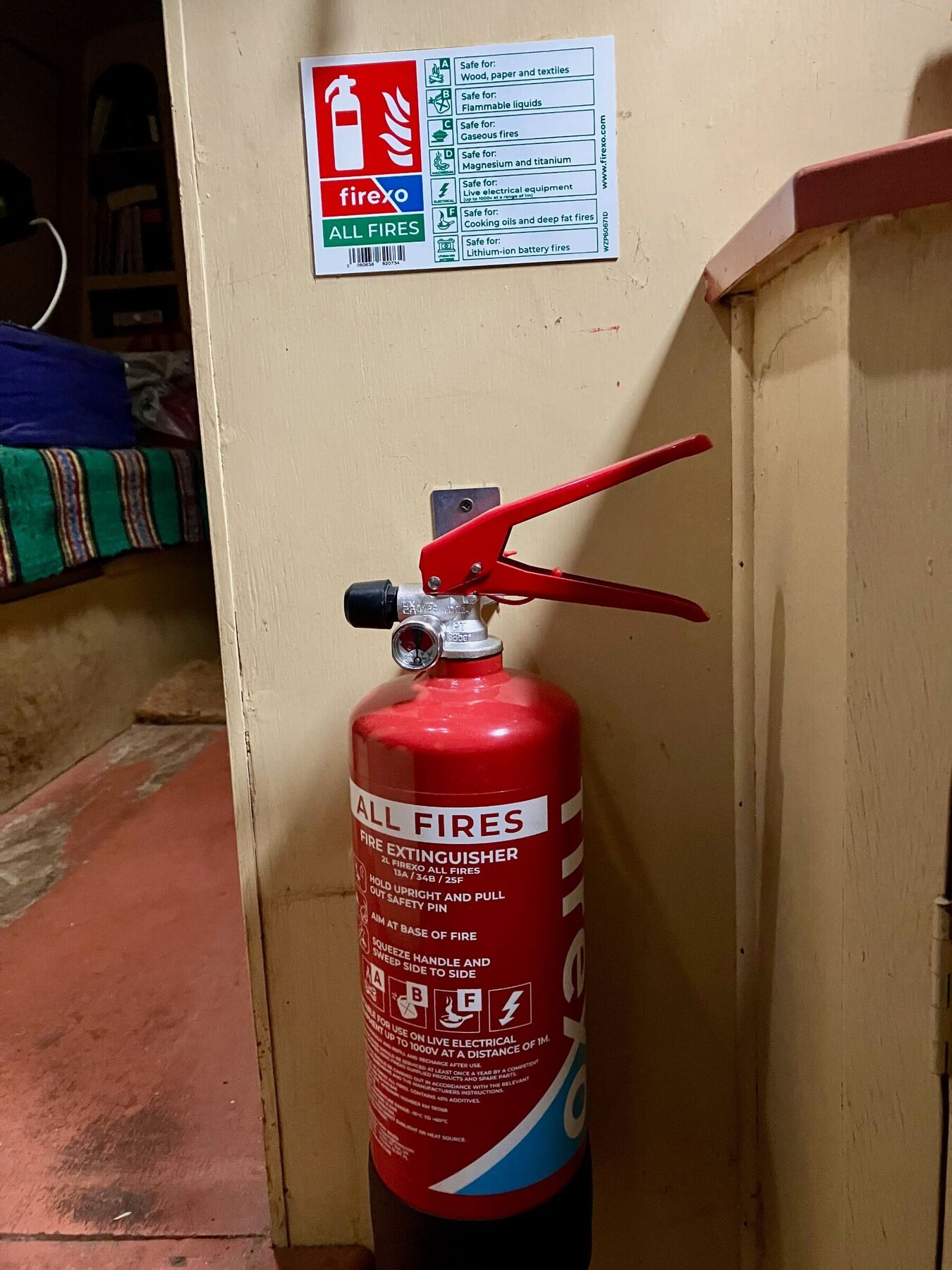
An AI enquiry gives you a good starting point by defining the respective situations and the appropriate mitigation: 'Lithium-ion battery fires are best extinguished using water or Aqueous Vermiculite Dispersion (AVD). Water provides essential cooling to stop thermal runaway, while AVD (suspending microscopic vermiculite mineral platelets in water) cools the cells and forms an oxygen-blocking, heat-insulating crust over the burning battery to prevent re-ignition'. However, the volumes of the suppressant materials required are the real problem. I extrapolated the volume of AVD required to extinguish a fire in a 10W battery to the amount I'd need to carry on my 60' narrowboat for my 30kW lithium battery bank and it amounted to 250kg and that was before taking account of how it was to be stored and distributed (and the weight/volume of said kit). Many lithium ion chemistries generate their own oxygen in a thermal runaway situation so the best that can be achieved is to keep batteries and the like cool with vast quantities of water. In theory LiFePo4 batteries don't generate their own self-sustaining oxygen, so that any material that excludes oxygen is suitable such as CO2 and powder. With expensive electrical equipment CO2 is preferred as it doesn't do any damage by coating components. To 'oblige' my insurance company I have replaced a 2kg powder extinguisher with a so-called lithium example but it is worth noting that while it has the necessary F component, the quantities of the A and B components are slightly reduced meaning that total of B on board is actually one unit less than the total required for the boat! I will be interested to see whether the BSS examiner spots this! (although for my own piece of mind I have retained the original unit making a total 7kg!). As far as this insurance-required extinguisher is concerned, my expectation is that it might put out a fire in a mobile phone battery and, just possibly, in a laptop battery. For the benefit of my insurance company I have taken its pic and invested in a large label which I'm sure will be at least as effective as the device itself .......,. Bottom line, however, is to follow fire service advice – and everything that IanD has been reinforcing above – and get out of the boat PDQ: thermal runaway = crew runaway!!
-
Braunston Tunnel An inspection by the Asset Management Team will take place on Thursday 30th July between 9:00am-12:00pm, as they will be undertaking a boat-based survey through the tunnel to assess and document the extent of damage reportedly caused by a wide-beam vessel. Given the confined nature of the tunnel and the need to safely conduct the inspection activities, temporary restrictions on navigation will be necessary during this period.
-
Hope you have a good Wash crossing. Let us know what it's like in a wide-beam please.
-
Then I'll be on my guard ..... and maybe just stick with the car boot ..........
-
-
-
Back in the 80s there was an excellent solid fuel stove shop in Ludlow. The owner was disappointed by the way that the range of stoves he stocked all shared a common fault: the glass sooted up with little or no provocation on medium to low damper settings, spoiling the view of the fire and the flames which is something that his customers were keen to enjoy. He therefore set about developing the 'airwash' system that ensured that smoke-free combustion occurred under all damper settings in the vicinity of the front glass door panels. And so the Clearview stove was born – as far as I'm aware the first effective system for maintaining a smoke-free view of the flames. At the time I was installing a wide variety of solid fuel stoves in the area and his development was unique ... and consequently his stoves became very popular. How things have consequently developed I have no knowledge (as I moved on) but I think he deserves credit for what was effectively his invention. subsequently no doubt much copied!