.jpg.a75781cc8fa211957b6d6b2012956cb7.jpg)
.JPG.97e87d83ff44dd2a325692394b3494a3.JPG)
Rick-n-Jo
-
Posts
458 -
Joined
-
Last visited
-
Days Won
1
Recent Profile Visitors
14,661 profile views


.thumb.jpg.6eda975bfbd77ccb6bef8f1b259453de.jpg)




Rick-n-Jo's Achievements

Community Regular (6/12)
49
Reputation
-
How will paying more tax help us to meet our emission targets? Are we to just use the boats less, or scrap them or leave them to rot? If the extra revenue was going to be used to develop alternative energy systems for heating and cooking as well as propulsion then possibly justified, but it won't. I have already invested in a potentially low emission boat (electric drive) but still need to buy diesel until a charging network exists. Nothing I can do to make that happen no matter how much tax I pay.
-
A somewhat different view of ours. Before And after a busy weekend.

-
Nearly got one some years ago when I was a seasonal bridge keeper on the Gloucester Sharpness. Fretherne swing beridge, big powered one. The wig-wag lights and sirens come on 15 seconds or so before the barriers start to descend, and Charlie decides to floor it to beat them. Comes up the sloped approach like the proverbial bat out of hell, gets slightly airbourne, unfortunately (for him, tee hee) left side wheels land on the kerb in a shower of sparks. Car continues under other barrier, but comes to a halt several hundred yards down the road, no doubt to contemplate his dented rims and possibly deflating tyres. O how I Larfed!
-
No there aren't, the bridges on the northern section are generous, as if they were planning it to be a broad canal.
-
14 years and still going, but then it is a 48V 24 cell traction bank. 2 x 3000va Victron inverters, on 24/7. All domestic 230V equipment apart from pumps and some led lights and fans. But...... 5Kw 48V dc diesel gen to keep it all going when not on shore power. Runs for a couple of hours every day or two depending on usage. System not very tolerant of neglect, so would not recommend if not live aboard. If you want to have all the functionallity of a house afloat, this is the sort of (expensive) kit required. For just camping aboard, go low voltage + small inverter and expect to wear out leisure batteries every few years.
-
I think the effect you describe is as you suspect caused by temperature. I have had this to a much greater degree during a recent journey in the hot weather. Traction battery bank, instead of falling, the absorbtion current rose from 20A to over 40A while the battery temp climbed from mid 30s C to over 50c. Reading around a bit I learn, an LA batts ability to accept a charge falls as temp increases, the current instead just passing through, and presumably further heating the electrolyte. (Ultimately leading to thermal runaway??) Had to restrict charge times for a few days to limit temp rise, now on shore power have been able to charge fully at a low current by using the shore current limiter facility on the Victron charger. Electrolyte temp now close to ambient and battery behavior back to normal, sitting on float at an amp or two. If you can, a fan or blower to cool the engine space would be a good idea, or some insulation/reflective foil between engine and batts. Getting warm shortens the battery cycle life considerably.
-
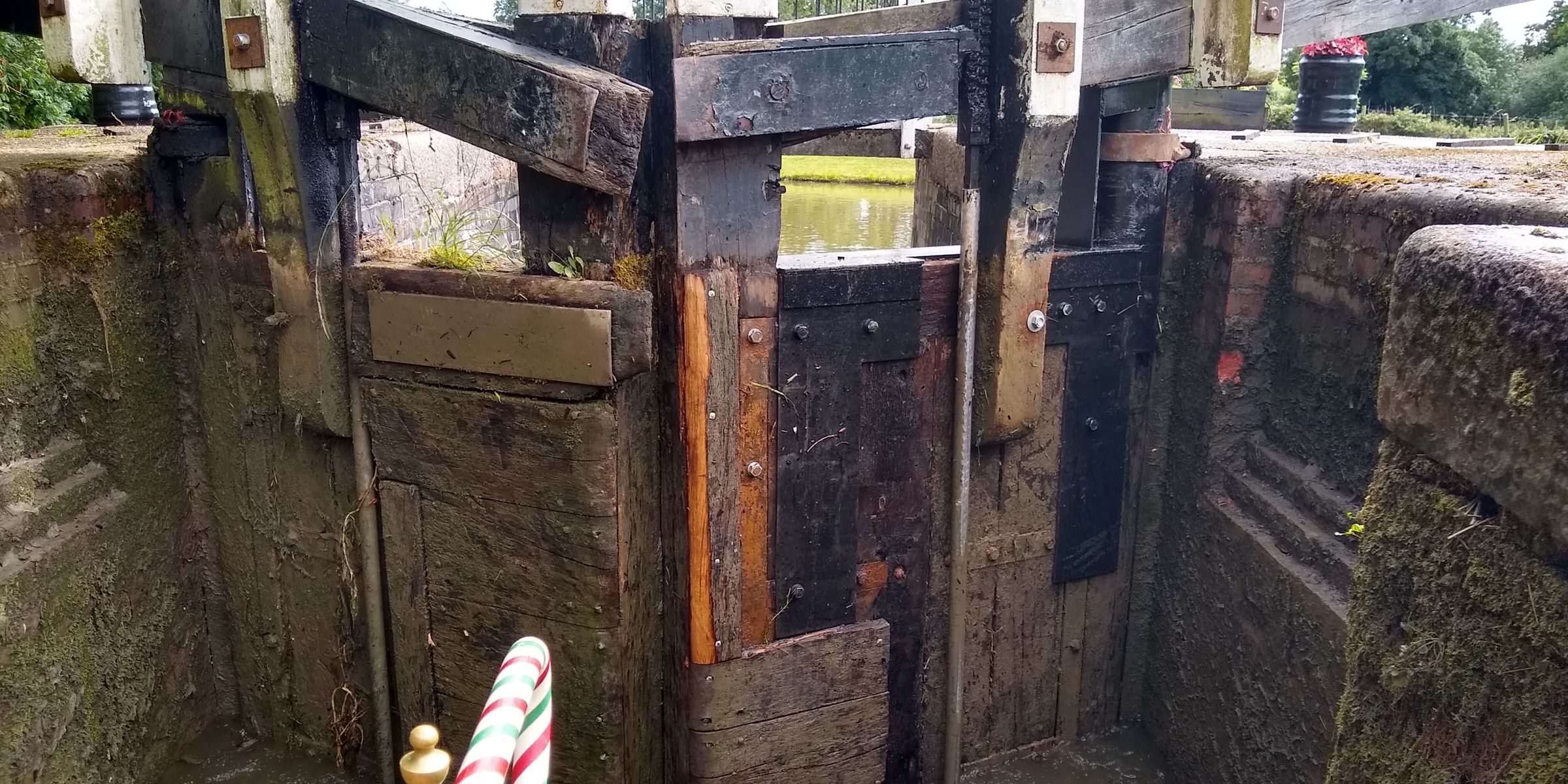
The flight actually re-opened at about 4 o'clock yesterday (Wednesday) about an hour after we arrived. The workboat with Hiab mounted crane was pulled back out of the locks, and the volunteers, who had spent the day greasing paddled and generally preparing, decided to stay on until 6pm. to get four boats up, maybe six down, prioritising those on a schedule like us, advising those planning to go through Leicester to wait or find another route. Despite being initially a but concerned that as we were hauling a butty it might take too long, the whole team were helpful, efficient and considerate. Seems thet're not insured for bow hauling so can't help with that, but everything else can't fault them. They are back at 8am today Thursday (not 10) to finish clearing the waiting boats. The patched up gate.
-
Think of a name. Paint it on boat. ( Seems a bit optional these days, but...) Drink beer. (Essential) After coming up with your highly original and possibly witty name, it's worth checking this site to see how many other people thought of it already!
-
Plan C then, back to going via Watford and wait till it's fixed., 144 locks, two boats, we'll be fit (or knackered)
-
I worked it on 2 mph and 40 mins a lock on narrow canals, hopefully pessimistic. 15 minutes for locks in flights, bow hauling the butty so working the boats independently. Think that might be a bit optimistic though since we're now only two handed thanks to Covid.
-
Yes, from Saul. No problem, phone Dave on 07710175170, really helpful. They are I gather being pretty strict over un-booked boats trying to follow through. Desperately short staffed apparently.
-
Was due to depart Gloucester Docks today towing a butty, bound for Debdale Wharf. Had to revise route to avoid Watford Locks, so Severn to Stourport, Great Haywood, Derwent Mouth and up the Soar. Checked the weather, stood for a while looking at the river, decided I didn't fancy it, cancelled lock booking. Wise choice according to the Gloucester lockkeeper. Wonder how soon we can go and can we still make it by July 6? ?
-
15/06/2020 15:44 Following the failure of the off-side gate, lock 3, on the Watford Flight on Friday we have now made the gate safe. A Trust engineer has inspected the damage and ordered replacement parts. A plan to safely lift the gate is being put together and we hope to be able to issue more positive news in the coming days.
-
Well it depends on the pace, at the walk they have a four beat rhythm, actually more a 2+2, think John Lennons Imagine. The trot is the classic two-time beat clip clop clip clop. The canter is your three time, with a moment of suspension when all four hooves are off the ground; one foot, diagonal pair, last foot, clip CLOP clip - clip CLOP clip. The gallop is a four time pace, but often sounds more like rolling thunder. Nothing to do with canals? Boats were normally towed at a walk, short trots are possible. Fast passenger boats apparently went at a canter with one or two horses, one being ridden, and were changed every couple of miles on the fly (without slowing)! I really find it hard to imagine how that was done.
-
Since the red lead is no longer available (banned by the nanny state(s)), I treat any rust then Craftmaster grey zinc primer, followed by raddle red if I want the red lead look, or the undercoat and gloss of choice. CM natch. It's brilliant, just works. Expensive, yes but if I'm doing the job I'd rather do it right and only do it once. YMMV
.thumb.JPG.5226ba392110cfee6a1093356263f2e8.JPG)