

nicknorman
-
Posts
23,279 -
Joined
-
Last visited
-
Days Won
119
Content Type
Profiles
Forums
Events
Gallery
Blogs
Store
Everything posted by nicknorman
-

Another way to skin the lithium cat - Victron lithium install
nicknorman replied to PeterF's topic in Boat Equipment
Not true. Some teslas use LFP. Some use NMC. You should know, you designed the Teslas. Maybe you forgot, what with all the other stuff you have designed? -
Another way to skin the lithium cat - Victron lithium install
nicknorman replied to PeterF's topic in Boat Equipment
LiFePO4 life is about energy throughput rather than cycles. But also high rates of charge discharge are more damaging than the same energy throughput at lower rates. Narrowboat batteries tend to operate at low rates, for example our standard rate of charge is 90A out of 6000Ah capacity ie 0.15C. It would take 7 hrs or so to recharge your Tesla at the same rate. And we discharge at an average of perhaps 0.014C ie very slowly, with very short periods at a max of ~0.3C. A Tesla can create a very rapid discharge when you floor it. So I would expect LiFePO4 in a typical narrowboat application to last a lot longer than the same battery in a vehicle before any capacity loss is noticed -
Another way to skin the lithium cat - Victron lithium install
nicknorman replied to PeterF's topic in Boat Equipment
1) haven’t checked recently, I think the lowest recent SoC (as measured by the BMV and therefore not aware of any capacity loss) was around 20% and certainly there was no hint of hitting the “bottom knee”. I doubt we have even grazed the surface of the 5000 or so cycle life. 2) unknown, certainly no top imbalance has occurred 3 I had 12 cells, (3P4S) the voltages were at very similar voltages and whilst I connected them all in parallel and left for a day or two, the very flat voltage vs SoC gradient meant they still needed properly “top balancing” which I did by generally well charging the array, and then put my bench power supply on each cell to take it up to 3.6v. I connected it all together on the boat and it was OK but at that stage I hadn’t written the code for auto-balancing. It didn’t matter too much because the BMS and alternator controller worked on the highest cell voltage, so it just meant that when the first cell (group) hit 3.6v, charging stopped eve though the others hadn’t quite got there so I lost ~0.1% capacity. 4) Once the auto-balancing code was written and with a few full charge cycles, it all got into balance and remained so for maybe a year until I noticed the auto-balancing kicking in. Long story but it turned out there was a bad internal connection in one of the cells, and so actually the auto”balancing” was auto”unbalancing”. Fixed the issue, some more auto balancing and it was fine again. This demonstrated the usefulness of clearly visible individual cell voltages and that balancing is kicking in, which on my display is an asterisk next to the cell voltage. The display comes on automatically when the engine is running or fast charging from the Combi. That was all maybe 3 years ago, since then I’m pretty sure the auto-balancing has never needed to kick in again. I think the cells will only go out of balance if there is some sort of fault, or a crappy BMS that takes too much current from individual cells. -
I think they are definitely reading this, got a phone call from the accounts lady (who is very nice) to confirm my bank account details, and she’s sent me a balance statement showing the key refund minus the March electricity bill, and the money is now in my account. So no complaints about that one! Fortunately we have on board washing machine and dryer.
-
Whilst we didn’t have any issues with ABC when they owned the place, they did take a year’s worth of mooring fees from us with (on my part) a presumption of 7 days/week services and reasonable security, and then after 6 months sell out to Rothen who proceeded to reduce services to 2 days a week (and closed completely for 2 weeks over Christmas) and remove all security by opening up a path from the towpath into the marina and declining to fix the pontoon gate lock. So I felt ABC had rather abused my trust in giving them a year’s mooring fees up front. But then again they probably didn’t imagine Rothen would turn the marina into what it is now. Anyway, I need to move on because the new marina is excellent. I am however wondering if/when I will get the £100 back from Rothen that they demanded in advance for the gate key fob (free at the new marina by the way). They got it back on Monday, no sign of my money back yet so clearly they aren’t rushing! The reciprocal mooring thing was good, as was the 10% discount on fuel at any ABC marina.
-
That’s not a suitable charger for lithium batteries.
-
Aha! They’ve obviously been reading this thread. Website is now updated to the correct county and the correct canal.

-
Well, day 1 at Aston, mightily impressed. Marina staff super friendly and efficient, everything spotless and organised, lovely lighting at night, and we splashed out on a meal in the restaurant which was excellent with exemplary service. Can’t fault it so far. And all for £500 less than FMM (although we will probably spend the £500 in the restaurant and bar!).
-
What about the Ribble Link though?
-
Well we've arrived at Aston Marina, made very welcome, great berth near the marina office and not too near the wedding venue, enjoyed a drink on the terrace and splashing out on a meal in the restaurant tonight. Chalk and cheese from FMM 2.0. No before you start I don't mean we are having chalk and cheese for dinner.
-
No a different Kat, the Marina Manager is Kathryn. No reply from Ian to my polite and courteous email after 36 hrs so probably not going to get one. I do find it very odd that he seems not in the slightest bit interested in why people are leaving in droves. Refusal to engage at all with customers or even listen to any feedback is not a good look for any company. They are either very stupid or have a cunning plan that doesn’t involve moorers. I suppose what particularly irks me is that Rothen has made sufficient profit from CRT to build a new marina, then extend it significantly, then buy another long established marina seemingly as a plaything and not concerned about its financial viability. And no doubt pay themselves handsome dividends and salaries as well. That money, which in part is our money and also taxpayers money, should be going to maintaining the system, not falling into private hands. I suppose it’s not Rothen’s fault particularly (although they clearly don’t feel too bad about profiting from canal maintenance funds) but mostly lies with the CRT policy of outsourcing everything.
-
According the BMV. Or just discharge until the voltage gets to about 11.5 or so. Or even until a low voltage disconnect. Just put it on charge straight afterwards. Just cell voltage of the lowest cell. Although it might also have an overall low voltage cut off too. Certainly nothing to do with SoC.
-
I suggest discharging it right down to 10% or so. Don’t forget that taking Li to 10% is in not damaging although it’s best to start charging again fairly soon. Taking it up to 100% is worse!
-
How many reasonably deep cycles has it done now? Mine got much better after 3 or 4 reasonably deep cycles. It is pretty good now. Its a year or so old now, so I doubt it would be a more recent firmware version than yours.
-
I don’t believe Peukert has any relevance to the SoC of a Li battery. But then again, neither did it for an LA battery. It was a myth, legend and mantra that I didn’t believe in. You did leave the “get a room” post which is now a bit confusing!
-
The Victron BMS seems a good design in many ways, particularly impressive is the ability to limit current at 100A without dissipating too much heat (presumably). It would of course work best in an all-Victron system. But for me there would be a couple of issues relating to alternators, firstly that max current is 100A whereas I can easily run our ubiquitous Iskra 175 alternator at 125A without overheating, and that could probably be 140A or more with better cooling. Secondly, these big alternators even on a fairly large engine like our Beta43, sap a lot of torque from the engine if field current is max at low revs, making it struggle to accelerate from idle and putting a lot of stress on the belt, pulleys and crank. 100A at idle is too much. Really one needs an alternator controller that reduces field current at low rpm (Wakespeed etc). And with a proper alternator controller, the need for the Victron external BMS more or less disappears.
-
Mid summer, quite a few boats are out cruising, including ours. The same photo taken now would look very different. You could pop over with your drone… Interestingly there’s just been a post on the FMM moorers Facebook page from the new Jules Fuels fuel boat lady. Apparently they have been given permission to sell within the marina, so I would presume FMM is going to stop providing services (fuel, coal, gas) altogether even to the moorers.
-
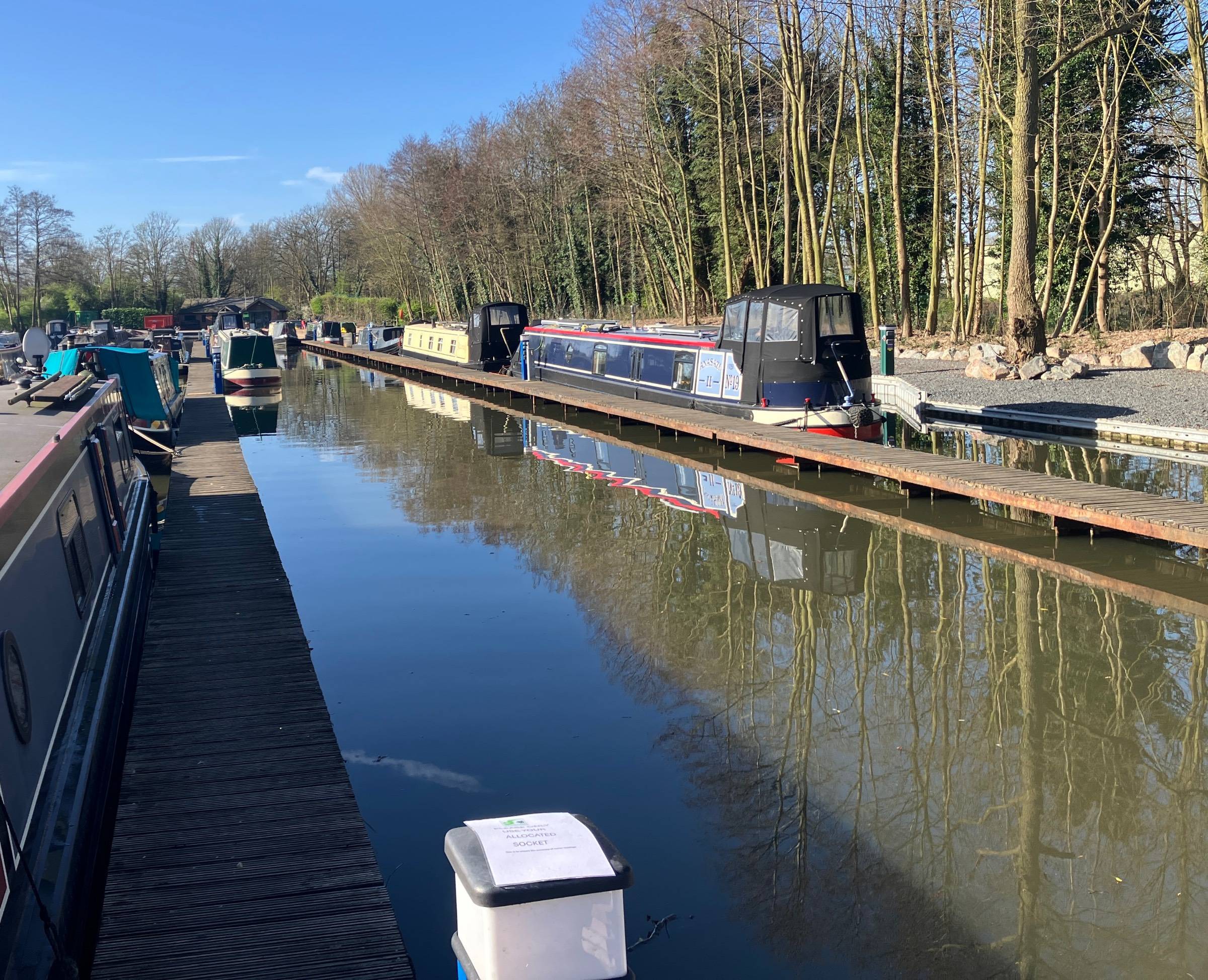
Yes people in marinas do take their boats out sometimes! But at the marina in question I’d say occupancy was getting close to 50%. I am aware of 9 boats that have left recently, all previously long-termers like us. Whereas at the new marina there was a waiting list. Here’s a pic of a different part of the marina and bossy note from kat on the bollard!
-
That’s good. Kat will be spitting feathers if she sees that on her CCTV screens! Yes Ben is a lovely chap, I did mention that upthread. Not sure he will last long though. Last night I emailed Ian Rothen asking if he would be interested in feedback as to why we and so many others have left. It will be interesting to see if I get a reply.
-
I sympathise muchly. A horrible job and the chances of your clothes escaping without holes seems slight. I’d continue with the bicarbonate of soda treatment for as long as possible, maybe do a rinse and repeat a few times. You will get it sorted eventually!
-
That was the other Tony. I always suspected there was a fault with the other alternator (blown diode etc).
-
Personally I’d call it a buffer battery. Not that it matters what you call it!
-
B2B current flows one way, but of course a box of tricks might well have 2 B2Bs in reverse parallel. And of course faster than light travel of information is already available, just awaiting a firmware update. I think what is relevant about that is that the B2B continues to charge the engine battery even after the van engine is stopped. So if the engine battery is running at a deficit for a few hours, this will be recouped overnight or whatever, by being charged from the domestic Li battery. It would be interesting to know if the van could tolerate very long drives without lengthy periods of the engine being stopped (overnight etc).
-
So as I said, it is unidirectional. No doubt it could in the future be made to be bidirectional. Along with faster than light travel, coming soon…
-
If it is MOSFET switch then it’s the same as a relay. A direct bidirectional connection. A B2B is not a direct connection even though the circuitry might contain MOSFETs amongst other things. Input and output voltage of a B2B are likely to be quite different, unlike a relay or VSR. And current can’t flow bidirectionally.